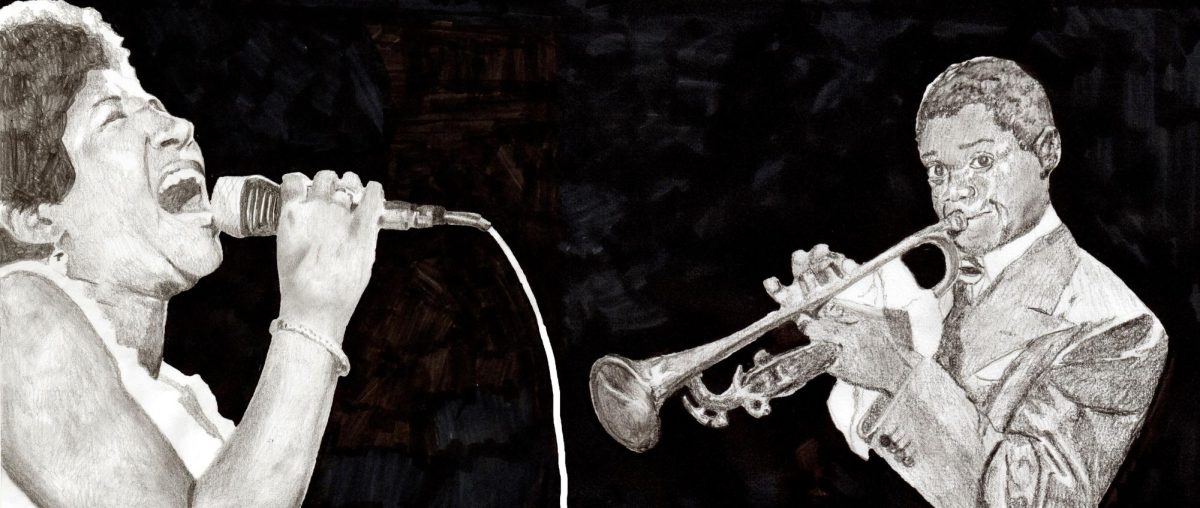
Black musicians have left a historic mark on every genre of music, from jazz to rock, from pop to classical, they have left traces in every note. It can be easy to overlook the achievements and legacy of Black influence on music, but there are countless references that show us their importance. This piece will only touch on a few, but there is always more to be learned and more music to be listened to.
Louis Armstrong was a major player in making jazz what it is today. Armstrong got his start as a highly sought-after cornetist in New Orleans, until 1922, when Joe “King” Oliver – the top cornetist in the city – recruited Armstrong to his band. He left in 1923 to try to make it on his own. In the 20s and 30s, his band, “Louis Armstrong and His Five” (later known as Louis Armstrong and His Hot Seven), completely changed the energy of jazz from an ensemble-based genre to a place for soloists to shine. Armstrong’s improvised solos and soulful vocal scats made him stand out and leave a historical impression on the genre.
The first woman to be inducted into the Rock and Roll Hall of Fame, one of the most honored artists in music history with eighteen Grammys, “Lady Soul,” Aretha Franklin. We’ve all heard the name, as she holds a strong influence over the genre of soul. She didn’t just use her voice to sing though, she was a strong and powerful symbol during the civil rights movement, advocating for racial and gender equality. Her cover of “Respect” by Otis Redding was an anthem for the movements of the time. Her rich, powerful voice that shaped soul into what it is continues to ring out today.
Whitney Houston was the first and only artists to hit seven consecutive #1 hits on the Billboard: Hot 100, the first woman to enter the Billboard Hot 200 Albums at #1, and one of few solo artists to have eight consecutive albums go multi-platinum. Her first, self titled, album released in 1985, with three #1 singles and “Saving All My Love For You” winning a Grammy for best pop vocal performance. She was immediately a standout, and this album set the record as the biggest selling debut album by a solo artist.
We all know Beyoncé, between “Single Ladies (Put A Ring On It),” “Crazy In Love” and “Break My Soul,” from “I Am…Sasha Fierce” and “Lemonade” to, more recently, “Renaissance” and “Cowboy Carter.” She holds the records for the most Grammys, having won thirty five and been nominated for ninety nine. She got her start on a TV talent competition in a girl group, though they didn’t win, they went on to form Destiny’s Child, releasing their first, self titled, album in 1998. Solo, Beyoncé has sold a total of thirty seven million copies over eight albums.
Kendrick Lamar, the 2025 Super Bowl performer, twenty two time Grammy winner and not to mention a Pulitzer Prize winner – the first for a non-classical or non-jazz album – for his 2017 album, “DAMN,” is nothing short of legendary. He’s known for his famed lyricism and critiques on institutionalized racism in the United States. We all saw, whether live or on social media, his 2025 Super Bowl performance. He had the platform and the chance and he used his voice to make his commentary on the political state of the US, a call to revolution.
Though we have all heard of all these artists, the sheer impact of their work and their achievements can be easily lost. During Black History Month, it comes easier to hear about and learn about the achievements of African American artists and people, but it is important to seek out this information all year-round. The impact that Black artists have had in each and every genre of music is something to be recognized and celebrated.