

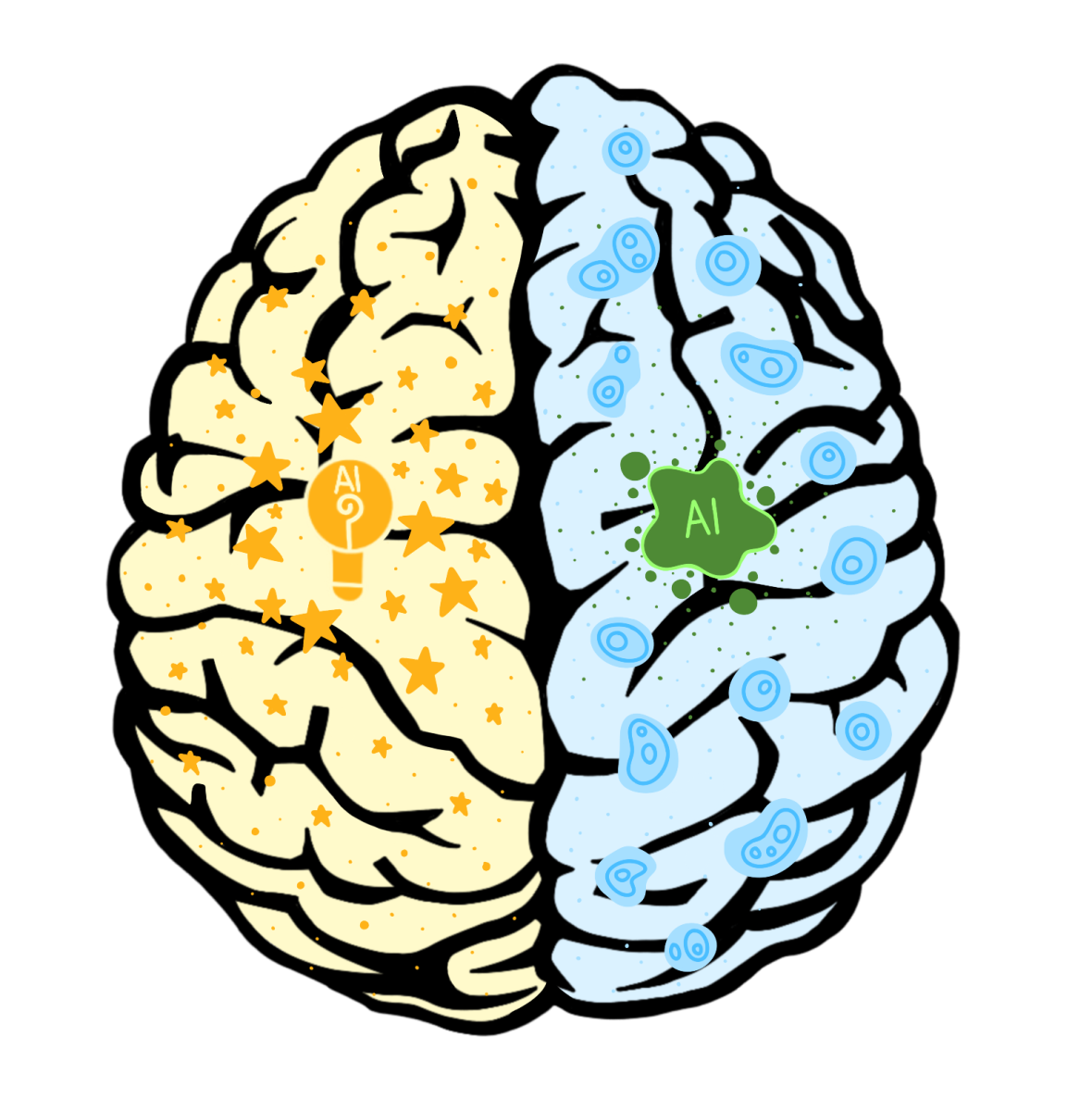
Helps human intelligence
Even though AI empowers a more productive, creative, and innovative world, most media about AI is filled with concerns. Pessimists worry that it will facilitate student cheating, take human jobs, and make us dumber. However, while managing AI is important, we also must look at the upsides. Among the many benefits: AI will make us more intelligent. How will it do this? By advancing access and equity in learning, improving assignments, and taking on repetitive tasks in a way that enables us to think bigger.
AI has the ability to create and supplement learning resources, giving students more effective ways to learn. One study from Georgia State University found that college students who used AI-powered teaching assistants did better in classes. Given AI’s easy accessibility, this benefit could be available to a wide array of people at a low cost. In our schools today, wealth is a major dividing line of who can access high-quality, personalized instruction and who cannot. AI, however, has the potential to offer this learning across the income spectrum, making learning more accessible and equitable. Moreover, as AI gets smarter, the support systems will become stronger as well.
AI also gives educational institutions the opportunity to refocus learning. For example, President Michael Crow of Arizona State University is working to use AI to help prepare graduates for a changing workforce. He also uses AI to make assignments more meaningful, believing that if AI can ace a test, it’s too easy. Moreover, many teachers now have their students defend papers in oral presentations to ensure they have learned the material. This will ensure that all students learn more fully and even build presentation skills.
Furthermore, AI can be used in the workforce to complete monotonous tasks, allowing workers and students to do only the most transformational and educational parts. In fact, according to researchers at Temple University, “AI can enhance creativity and job satisfaction, particularly for highly skilled workers, by taking on repetitive tasks and allowing employees to focus on more meaningful work.”
Hence, AI can be used for tasks like scheduling, billing, answering customer questions, data entry, and inventory management. With these tasks out of the way, humans can focus on more innovative tasks that expand human intelligence.
Stanford research cites other possible uses of AI in education, such as supporting teachers and improving tests. Indeed, teachers at ETHS are already beginning to encourage its use. Sophomore Lyra Rivera, for example, said her teacher had the class use AI as a required study tool for tests. Even though Rivera cited concerns about mistakes in AI responses (which she received multiple times from her question), the assignment showed Rivera how AI can be used positively. “Using AI in this way helped me challenge my thinking in ways I wouldn’t have thought,” Rivera said. Rivera is not alone. In fact, according to the Digital Education Council, 86 percent of students use AI to help with schoolwork.
While concerns about cheating understandably run rampant, they may be overblown. Stanford researcher Denise Pope found that students in the age of AI may not actually be cheating more than their predecessors. They are just cheating differently. As cheating changes, moreover, teachers will find new ways to regulate it–just like they did when previous technologies like calculators and Google came out. We can now do the same for AI. Indeed, teachers are already using AI detectors and Word documents that check for student copy-pasting and that show time lapses of student writing.
When the internet started to become accessible, people had many similar concerns to the ones about AI today. They worried that the internet would make cheating easier and put entire industries out of business. Today, however, people overwhelmingly view the internet as positively transforming the world. The reactions to both the internet and AI are examples of humans’ natural resistance to change. In the case of AI, the fear is exacerbated, given that we don’t know exactly what it will be used for yet. The negative effects are more tangible in our minds than the positive ones, even if the positives will prevail in the end. Hence, concerns about AI hurting human intelligence may be largely due to human nature rather than an objective outlook.
By viewing the situation through a less biased lens, we can see AI’s many benefits for human intelligence: it could make learning easier to access for people across different socioeconomic statuses, improve classroom assignments, and replace monotonous tasks with transformational ones. Given modern standards in journalism, I didn’t use AI in the writing of this assignment. My arguments, however, might have been even better if I had.
Hurts human intelligence
Ever since the launch of OpenAI’s ChatGPT over three years ago, the use of AI in schools has increased exponentially. Today, numerous AIs play a role in our daily lives, including Google Gemini, Claude, and Apple Intelligence. In short, this brilliant technological advancement has found its way into our homes, workspaces, and, perhaps most of all, our schools. However, rather than elevating the learning experience, AI poses a genuine threat to how we educate ourselves.
As stated earlier, AI has become routine in our daily lives—after all, with every search on the web, Google Gemini pops up. In short, it’s super easy for students to use AI, but this poses a threat to education. Social sciences teacher Mr. Ginsberg stated, “AI is not only not good for learning, but is something of a scourge. Students aren’t learning how to think for themselves due to its ease of use and the difficulty in detecting it.” When students can generate virtually whatever they desire with the push of a button, they no longer need to put in effort themselves on a specific assignment. They will build a reliance on the tool, not on their brains. Dr. Karishma Edgar, a professor at the University of Michigan, stated, “[AI] is quick, convenient, easy, and designed to be this way. It’s actually marketed to be addictive, just like social media or fast food. Also, remember that the goal of the companies’ marketing and selling AI services is for users to get hooked onto them.”
In addition, although the hype of recent breakthroughs in machine learning may tell us otherwise, AI is prone to making great mistakes or hallucinations. “On one test, the hallucination rates of newer A.I. systems were as high as 79 percent,” according to an article from the New York Times. Many are caught up in the false belief that AI is perfect, and will blindly believe everything they read. This will give them an incorrect perspective in whatever field they are learning.
“I have dystopian fears,” Ginsberg reflected, “that we will have whole generations of people who can’t think for themselves but instead rely on what they are told by AI.” The brain is a muscle, and just like every other muscle, when you don’t exercise it, its cognitive abilities become limited. In a CNN interview, MIT’s Dr. Nataliya Kosmyna shared, “Those folks who [used Large Language Models (LLMs) in previous tests] and then use[d] their brain to write an essay actually showed weaker neural connectivity compared to brain-only folks. And those who first used the brain [in the previous tests] actually showed high neural connectivity.” When students rely on AI’s help for their assignments, they’re not able to grasp a full understanding of the topic. This can severely come back to haunt them in the future during an important assessment, similar to what we commonly see during finals. As Wildkit Alumni Sachin Jain (Class of ‘25) quoted from math teacher Mr. Javia, “‘We as a society would be allowing machines to have critical thinking skills rather than humans.’”
Ginsberg continued, “which of course reflects the biases and predilections of people in power.” That brings up another point: AI is very biased. In simple terms, AI is an algorithm that sorts out data, typically being information from the internet. The information the AI model gathers, however, can come from a relatively small number of websites, which makes many AI models biased in line with those sources.
AI isn’t just “theoretically” biased either: it’s proven. The Stanford Report claims “answers generated by LLMs [a common type of AI program] may have a noticeable partisan bias.” OpenAI is left-leaning. DeepSeek has a noticeable pro-China slant; “DeepSeek is unresponsive to topics that are sensitive concerning Chinese political history,” The Center for Strategic and International Studies claims. By relying on AI’s words and not our own, our thoughts and beliefs will be decided, not by ourselves, but by a machine.
A common counterargument is that AI is good for studying. Now, I will say that tools like NotebookLM do indeed help me, but there is a correct and incorrect way to use them. Edgar stated, “For students who use it well, AI will really boost their ability to learn! If you are curious about concepts or topics, you can learn much faster, and that’s exciting. If you are using AI to do your work, then it’s going to be difficult to really get through higher education and life after, [because] you never really committed concepts to your long-term memory.” In addition, a common trend I see with students is that, instead of first going through the problem themselves, thinking through each logistical step, they ask AI to explain it to them at the first sign of a roadblock. Just like how you have to exercise more than is comfortable to strengthen your muscles, you have to think more than is comfortable to strengthen your mind. If you rush to Gemini’s assistance whenever a problem is trickier than you’re used to, your brain will never grow, nor understand the material.
One of my favorite movies growing up was Wall-E, but I never truly understood the main idea or the theme of the film, at least not until AI flooded the mainstream. The whole idea of machines doing all of our work for us is becoming a reality, and as we use it more and more, we lose a bit of ourselves in the process—creativity, thinking critically, and responsibility. After all, who’s the real student: us, or the machine?







Miguel Lomb • Feb 22, 2026 at 4:28 pm
Very interesting! So cool that you interviewed such experienced people!