

At its Jan. 12 meeting, the ETHS District 202 Board of Education approved a restructuring plan that will eliminate 21 positions at the end of the 2025-26 school year. The move comes as the district’s expenditures continue to outpace revenues, leaving a budget gap of roughly $2.5 million for the 2026-27 school year.
The restructuring plan, which is projected to close the gap, focuses on the removal of non-classroom positions in order to minimize the impact on instruction. In total, 12 employees–four administrators, three exempt staff, three special staff, one secretary and one teacher–were laid off, seven positions were already vacant and two employees were restructured or reassigned (for example, the World Languages Department Chair and Director of Multilingual Services positions will be combined into a single role).
According to Principal Dr. Quiana McNeal, the eliminations are a strategic move aimed at preserving long-term financial stability.
“These decisions are rooted in what is best for students,” said McNeal. “Taking proactive steps right now even though they’re hard decisions makes me feel very confident that we’ll stay in a position where we can best serve our kids and be financially responsible.
Leading up to the decision to restructure staff, the school carried out alternative cost-cutting measures. The district decided to freeze administrator salaries for the 2026-2027 school year and implemented zero-based budgeting, where departments justify the amount of money they ask for at the beginning of each year in an effort to spend only what is necessary.
In addition, the district invested in sustainability initiatives like purchasing electricity and gas in bulk and using energy-efficient equipment, which have led to a decrease in utility expenses.
While these efforts saved around $1 million, the district still faced a budget gap. Under Illinois law, ETHS is limited by property tax caps that restrict district revenue. When school expenses rise faster than inflation, the caps limit the district’s ability to generate enough revenue to cover costs. According to the 2026 budget, this income accounts for 84% of operating funds.
Board policy requires a minimum reserve level of 33% of annual operating expenses, or around four months of cash, on hand. Without cuts, ETHS would likely dip below the minimum by 2028, so the eliminations were made in part to maintain a strong fund balance, or reserves. In fact, the district’s fund balance was used to pay staff and cover operating costs following Cook County’s delay in payments, where ETHS, in addition to other schools throughout the county, received its property tax payments nearly five months later than originally anticipated.
“That significant lag was really, really difficult for us,” said Chief Financial Officer Kendra Williams.
On Dec. 29 and Dec. 30, two Cook County payments–each of around 20% of the original balance–arrived. These payments narrowly prevented the district from moving forward with a loan from another school district that was scheduled for Dec. 30. However, the district has yet to receive 100% of funds from Cook County.
Even if the funds had been delivered on time, recent increases in costs for health insurance, transportation and off-campus student placements alone might have presented a need for restructuring. In 2024, the district spent roughly $9.4 million on employee healthcare. Facilities expenses were similarly high: the district paid approximately $766,000 to Constellation NewEnergy and $460,000 to Exelon, plus nearly $2 million to G.E. Riddiford Company for maintenance. Illinois Municipal Retirement Fund payroll, which tracks total compensation for employees, has also grown, with top salaries rising sharply and more high-salary administrative roles added.
At the most recent board meeting on Feb. 9, Williams presented the Annual Comprehensive Financial Report for fiscal year 2025, confirming a “positive audit opinion”. Even so, the report highlighted that the district’s total combined fund revenues reached $134.2 million, while total expenditures were $141.7 million.
In reviewing the audit, Williams addressed financial pressures discussed in the January meeting. She noted that while the district passed its sixteenth consecutive balanced budget, there are ongoing concerns regarding revenue stability. A key area of focus was the decrease in Corporate Personal Property Replacement Tax (CPPRT), which is a major funding source stemming from the income of corporations and partnerships. CPPRT and property taxes accounted for 63.5% of the district’s total revenues in fiscal year 2025.
Amid these circumstances, the administration stresses that the school is financially secure, citing its Moody’s Aaa rating, which recognizes excellence in financial reporting.
“ETHS is not in a budget crisis,” said Superintendent Dr. Marcus Campbell at the January board meeting. “We simply have to make adjustments to be sure that we are on strong financial footing for the next budget cycle and the foreseeable future.”
The plan has brought up concern for how the elimination of specific roles will affect the broader student experience, particularly concerning the Language Lab.
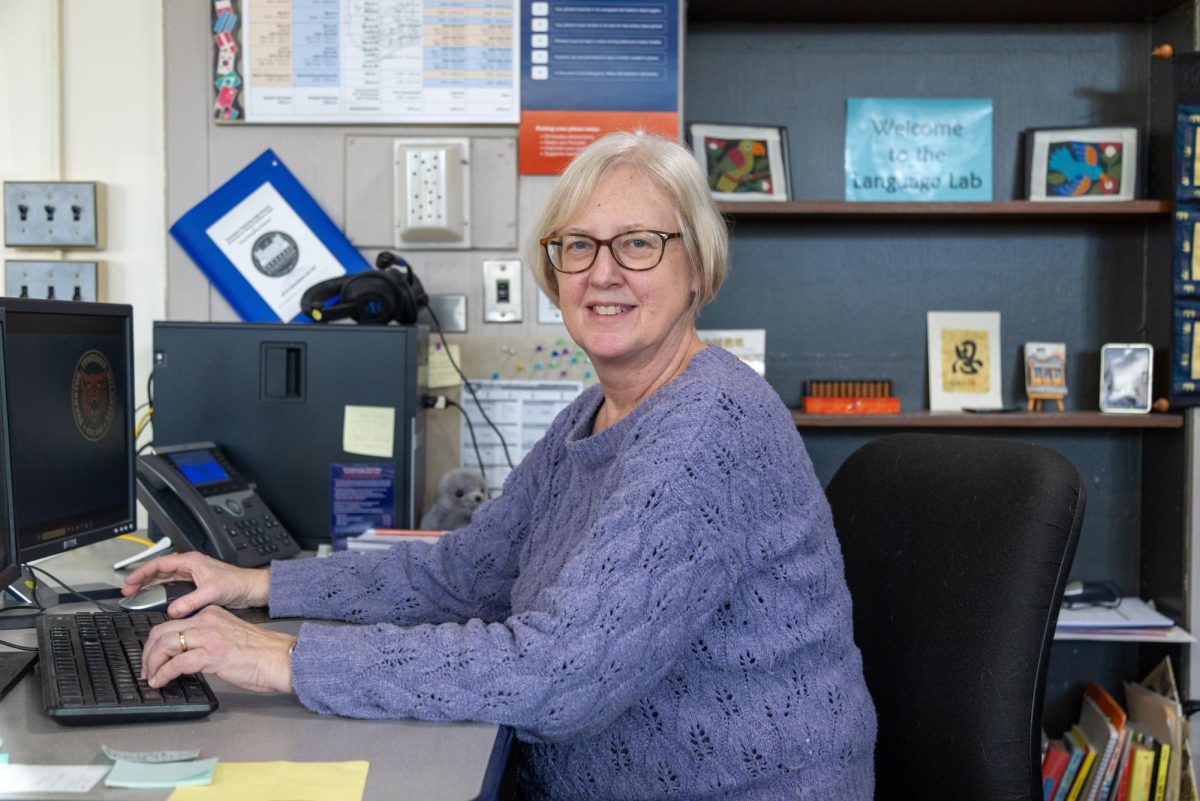
As World Languages Lab Specialist, Sherry Iverson assists teachers with high-quality listening and speaking software that is used for learning and assessing activities. Iverson’s role will be eliminated next year.
“I was told that [the administration] was looking at positions that were not student-facing, but I have a lot of students and classes that come to the Language Lab,” said Iverson
According to Iverson, 25 teachers consistently brought 97 different classes to the Language Lab throughout the year.
“You need a specialist, somebody in here to run the lab,” said Iverson. “If I wasn’t here organizing and fixing things, making sure repairs are made, calling the software company and ordering headsets or cords, I don’t think things would go very well.”
Iverson hopes that administrators recognize the value of the Language Lab and the services she helps provide.
“I had 76 students drop in during the week before finals to make up or redo an assignment,” said Iverson. “That was a very busy week because I had a lot of classes too; sometimes, every seat in the lab will be taken.”
The board has not yet specified how the Language Lab will operate next year, but has remained adamant about providing the same level of support to all students no matter the circumstance.
“It’s important to emphasize that we continue to be committed to the values and supports that have been established for our students, like restorative practices and multilingual services,” said Board President Pat Savage-Williams at the January board meeting. “Those are not going away.”
While the plan revolves around the elimination of support staff, one member of the ETHS Teachers’ Council–which supports and advocates for teachers in the building–will be laid off, replaced by an administrator with more seniority whose role was cut.
“I think the [restructuring plan] creates concern and worry for everybody who works here,” said Teachers’ Council President and history teacher Rick Cardis. “It creates that instability when people don’t know what’s going to happen next.”
Cardis believes that this decision has the potential to impact employees throughout the school.
“The feeling that you’re supported by decision makers in the building is really important,” said Cardis.
In December, the district informed individual employees that they would be laid off. These announcements came in advance of the hiring season for educational positions, which typically starts in the spring, to provide more time for employees to find alternative employment.
“As somebody who was in the position to have these conversations individually with every impacted staff member, this is very challenging and takes a huge toll on everybody,” said Dr. Scott Bramley, Associate Superintendent for Human Resources and Administrative Services, at the January board meeting. “I just want to recognize and honor the people we’re talking about.”
Over the next few months, the administration will better establish the redistribution of responsibilities among employees who remain and reevaluate whether additional measures to minimize costs need to be taken.
“While [the restructuring plan] will go a long way in getting us in line with where we need to be for our budget, it is possible that with further review and once we get through this fiscal year, we’ll have a more concrete picture of what we need to tweak,” said Williams.


