

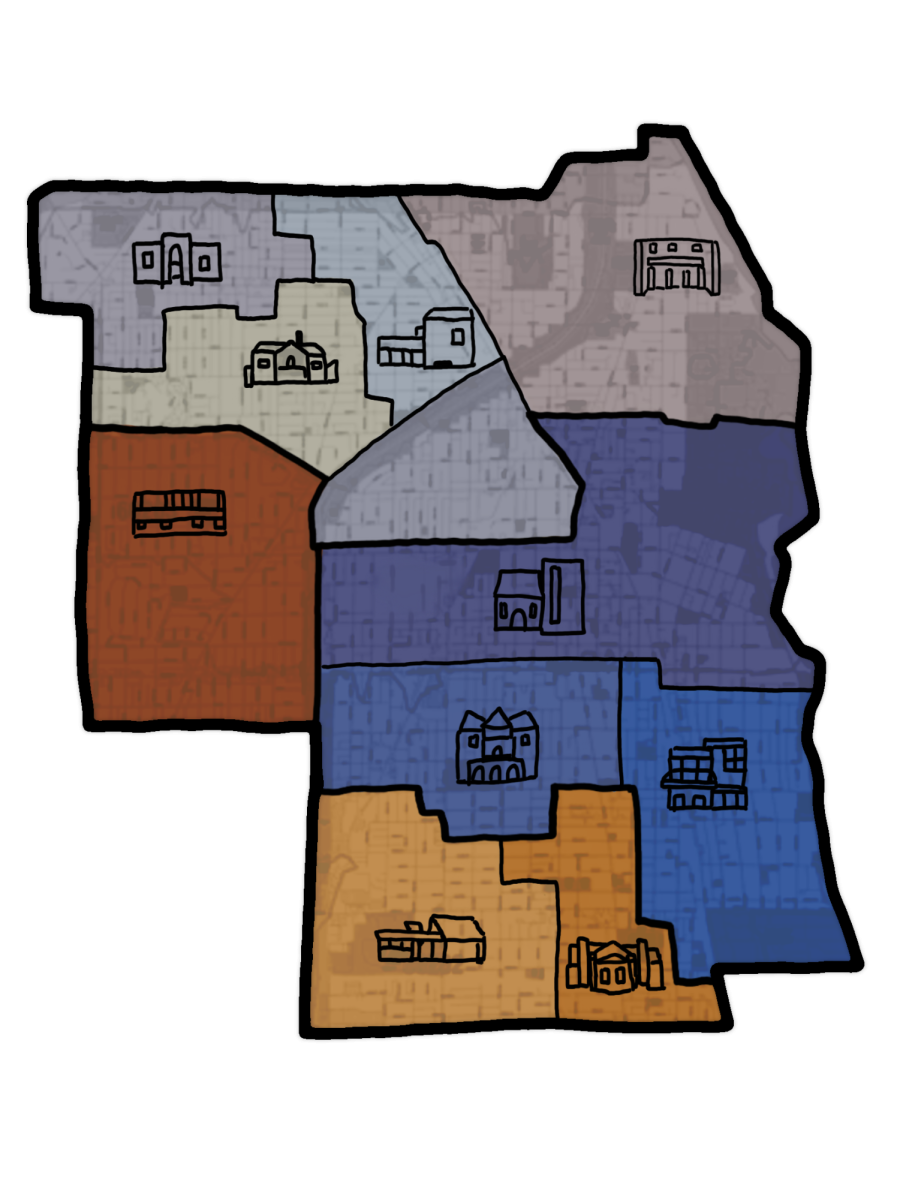
Visible throughout Evanston, yard signs proclaiming “Save Dawes” and “Salvemos el TWI de Willard” serve as public markers of anxiety gripping the community over the future of District 65’s elementary schools. This advocacy from parents and teachers alike is a response to the District 65 School Board’s plan to address budget concerns, which has reached its third phase of cuts, culminating in school closures.
On Sept. 29, seven scenarios for the future of District 65 elementary schools were presented to the board, suggesting the closure of zero to four schools in the Evanston-Skokie area. These scenarios were based on mathematical models of the impact that closing each school would cause, and the scenarios, especially the three- and four-school closures, aimed to minimize community impact while saving money for the district.
In the first two phases of the district’s Structural Deficit Reduction Plan, annual expenses have already been reduced by $20 million, according to the District 65 website. Now, these school closures make up the final phase in District 65’s plan to address a structural deficit in its budget, meaning the district is spending more money than it takes in every year.
“What’s still on the table is 10 to 15 million dollars of estimated reductions that need to happen,” said Pat Anderson, the District 65 School Board President, at the Oct. 27 board meeting. “There are some hard decisions in here.”
School closures are not only under consideration due to the budget deficit. The newest building in the district is nearly 60 years old, and all of the school buildings are old and in need of repairs, projected to cost about $188 million. Plus, a school is officially considered underutilized when it has a utilization rate below 80%, and District 65’s projected capacity for next year is 64% overall.
“There are three primary drivers that lead and will continue to lead these discussions,” said Anderson, mentioning a decline in student enrollment, school buildings in need of significant improvement and the goal of long-term financial stability for the district.
District 65 has seen a 24% drop in enrollment between 2018 and 2024, andsome believe this is due to both a demographic drop in elementary-school-aged children as well as an increase in the number of Evanston families choosing to send their children to private elementary schools.
“We know that over the last two years, approximately 190 students will matriculate into ETHS who did not graduate from District 65,” said Maria Opdycke, a District 65 board member. “They are going somewhere within our community, and we should find out why.”
ETHS Principal Dr. Quiana McNeal also pointed this out, adding that the high school is working with Evanston’s elementary schools to limit the impact of any closures.
“While District 65 has seen declining enrollment, we have not seen that similar trend at ETHS,” said McNeal. “We anticipate that there will be some impact, but we will learn through our middle school articulation as part of our course placement process.”
One factor that could be driving these school transfers is a growing mistrust in the school board, caused in part by the Oct. 9 indictment of former District 65 Superintendent Dr. Devon Horton. Horton was charged with using a district-issued credit card for his own use, concealing a job with another school district from the District 65 School Board and receiving unauthorized payments from consultants he hired on behalf of the district.
Horton’s indictment means there is enough evidence for a criminal trial, not that Horton has been convicted. News of the indictment has still led to uncertainty among Evanston families, who have called for board members to step down if they were on the board while Horton was superintendent.
“We are dealing with many factors that are affecting the process,” said Anderson. “I know that the indictment has really plummeted community trust, and we are here to rebuild it.”
Some changes within the district have already been decided and will take effect regardless of additional school closures. On June 10, 2024, the school board voted to close Dr. Bessie Rhodes School of Global Studies after the 2025-26 school year, similarly in order to reduce the district’s structural deficit. Meanwhile, the new Foster Elementary School in the Fifth Ward of Evanston is scheduled to open in the 2026-27 school year, restoring a community school the ward once had and eliminating the need to bus kids to schools far away from them. As for its long-term impact, the new Foster building has the potential to save $3.2 million each year.
“We have been focused on closures, but one of the additional components of this whole process is opening a new school, and I want that to be spectacular,” said Anderson.
Taking both the closing and opening into account, the school board then redrew attendance boundaries for Evanston’s elementary schools.
“In every one of our financial models, we offer back to the board what no school closings does and what that could do to the long term impact on the school district,” said Dr. Susan Harkin, a consultant hired by the district to assist with its Structural Deficit Reduction Plan.
Since the board decided that the closure of one or more additional schools is necessary, they turned to the “scorecards” for each scenario, measuring each scenario’s potential impact on the community.
Baseline scorecards rate each school individually from one to five in each category, with one being the least impactful and most likely to close and five being the most impactful and most likely to remain open. The ratings are based on several factors, each weighted differently: building cost (21%), equity (22%), building income (9%), building functionality (16%) and geography (32%).
After creating and analyzing the baseline scorecards for the closures of each individual school, the school board then looked at several scenarios that involved multi-school closures, creating new scenario-specific scorecards to fit the new attendance boundaries that different scenarios would require. On Sept. 29, seven initial scenarios were offered to the board beyond the baseline of zero additional closures.
Board members acknowledged that closing different combinations of schools also meant certain programs would need to be transferred to different locations or cancelled entirely. The Two-Way Immersion (TWI) program which allows students to take classes in Spanish and English with the goal of becoming bilingual, was closed at Willard Elementary School or moved to another school in nearly every scenario. The Structured Teaching Education Program (STEP), a self-contained special education program for students with Autism Spectrum Disorder, was also moved between schools in most scenarios.
At the Oct. 27 school board meeting, many Evanston teachers, staff and parents came forward with their concerns about the impacts of potential closures, especially on programs like TWI and STEP, as well as the methodology behind the board’s decisions.
“To trust that the scorecard rankings reflect reality, we need to fully understand how they were calculated,” said Daniel Rey, an Evanston parent with a background in mathematical modeling.
At the Oct. 27 and Nov. 3 school board meetings, Rey was one of several parents representing the Legion of Data Nerds, a group of Evanston parents who have backgrounds in data analysis and are pointing out issues concerning the school closure data. Another group of Evanstonians, led by Liz Wolens and Katie Armistead, formed Invest in Neighborhood Schools to encourage the board to consider cost-saving options beyond closing schools. The organization consists of over 1,000 members representing every elementary school in the district.
“Invest in Neighborhood Schools is focused on what is best for the community,” said Wolens. “I think the district needs to be more transparent, and it should partner more closely with the city and truly work with community members on creative solutions. There are a lot of good ideas out there and a lot of people who really want to get involved.”
In making their decision, the board tried to take into account the statistics as well as the opinions and lives of students, parents and teachers who will be impacted, narrowing down their options to three closure scenarios: one in which only Kingsley closes, one closing both Kingsley and Willard and one closing Kingsley and Lincolnwood.
“This plan that we’ve been working on has been focused a lot on numbers, but behind those numbers are children and teachers,” said Anderson. “I think the ultimate goal is really to take this process and move it to the vision for what we want to see happen moving forward.”
On Nov. 17, the board voted on those final three scenarios, resulting in a decision against the Kingsley-Willard scenario. The votes on the Kingsley-Lincolnwood scenario and closing Kingsley alone resulted in a tie, so all three of the motions were lost.
The board then shifted their focus to a Lincolnwood-only closure, scheduling a meeting for Thursday, Nov. 20, to vote on this new scenario.


