

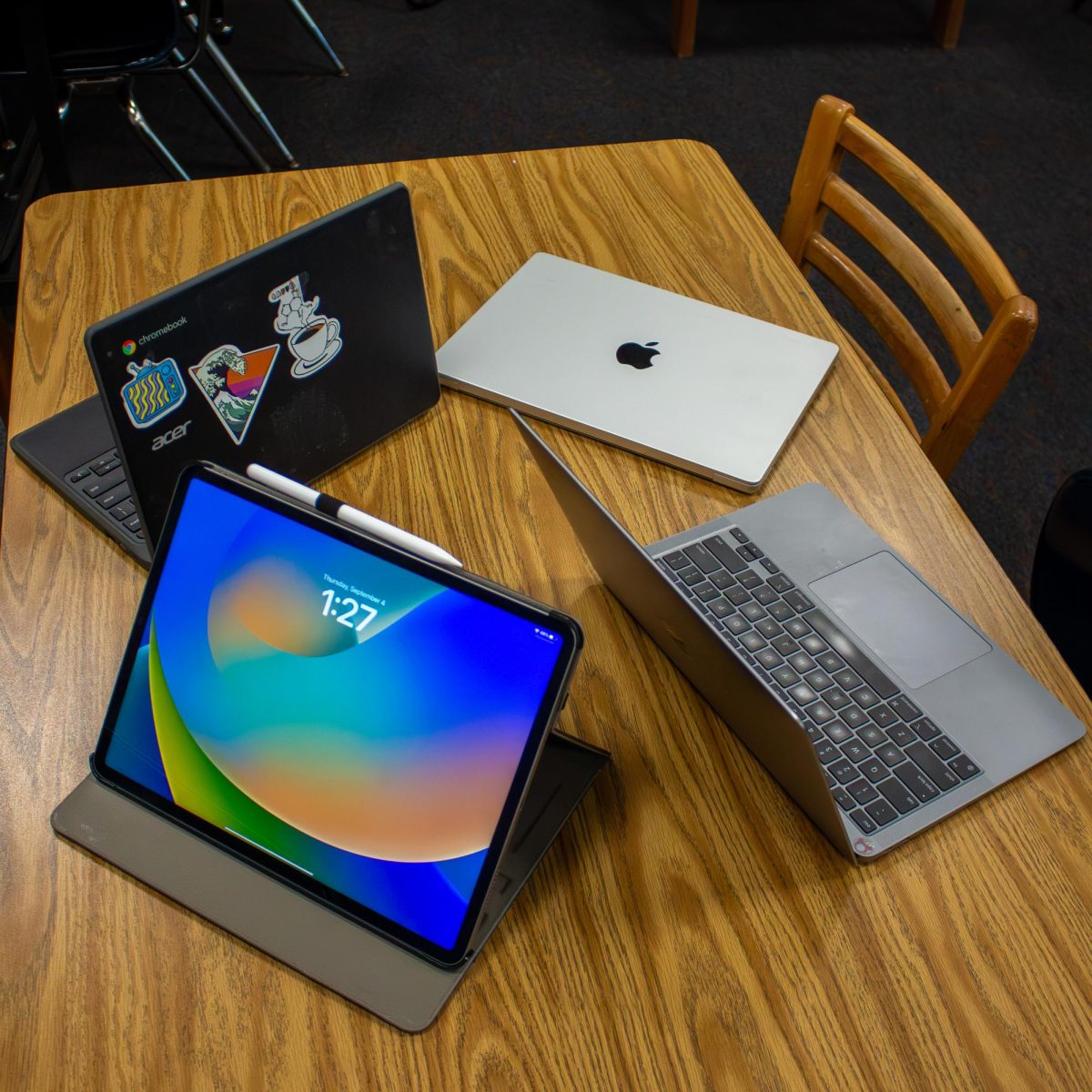
As the school year progresses, students and teachers are adjusting to ETHS’ new One-Device Policy. It is the second of two recent electronic-related shifts, following the implementation of the Cell Phone Policy last year.
In compliance with the One-Device Policy, students must use only district-issued Chromebooks at school. While Chromebooks have been the norm for many students, those who have relied on MacBooks and iPads over the years are left upset.
Despite student frustration, many teachers believe that the One-Device Policy will benefit student learning. German teacher Edward Gray has plans to limit technology altogether. In Gray’s eyes, any technology can be a distraction to the learning process. He points out that MacBooks and iPads are especially problematic because they can act as an extension of phones.
According to Gray, the One-Device Policy not only limits distraction but also addresses an important equity issue. He believes that any technology beyond Chromebooks is unnecessary and may inadvertently contribute to a negative classroom environment.
“For me, it’s about equity and quality of learning,” Gray said. “ETHS ensures that every student has access to a functioning Chromebook in order to complete their schoolwork both in school and at home.”
Gray highlights that personal devices cannot be monitored in the same way as school-specific Chromebooks. This can create problems when it comes to district-wide testing and class assessments.
“The authenticity of a student’s performance on a test taken on a personal device could be called into question,” said Gray.
Principal Quiana McNeal, an advocate for the policy, recognizes that students may struggle to understand the policy and adjust to it.
“It takes a while for people to get used to new policies,” said McNeal. “It’s important for students to use their school-issued Chromebooks so that we can monitor their activity and keep them safe.”
Senior Hartley Scales was disappointed when he heard about the policy. He argues that banning MacBooks does not directly translate to more focused, engaged students.
“Students can still be unproductive on their Chromebooks through unblocked websites,” said Scales.
Scales believes his MacBook allows him to do more meaningful tasks—like video editing, advanced coding and multitasking—without lag. He says completing schoolwork takes longer without it.
Not only that, but Scales argues that the new policy is not truly “financially fair”. After freshman year, he saved up money to purchase his own MacBook to use throughout high school. Since now he is unable to use it, he feels that he has lost a year of return on his investment.
As students and staff continue to adapt, the One-Device Policy will continue to shape daily routines at ETHS.


