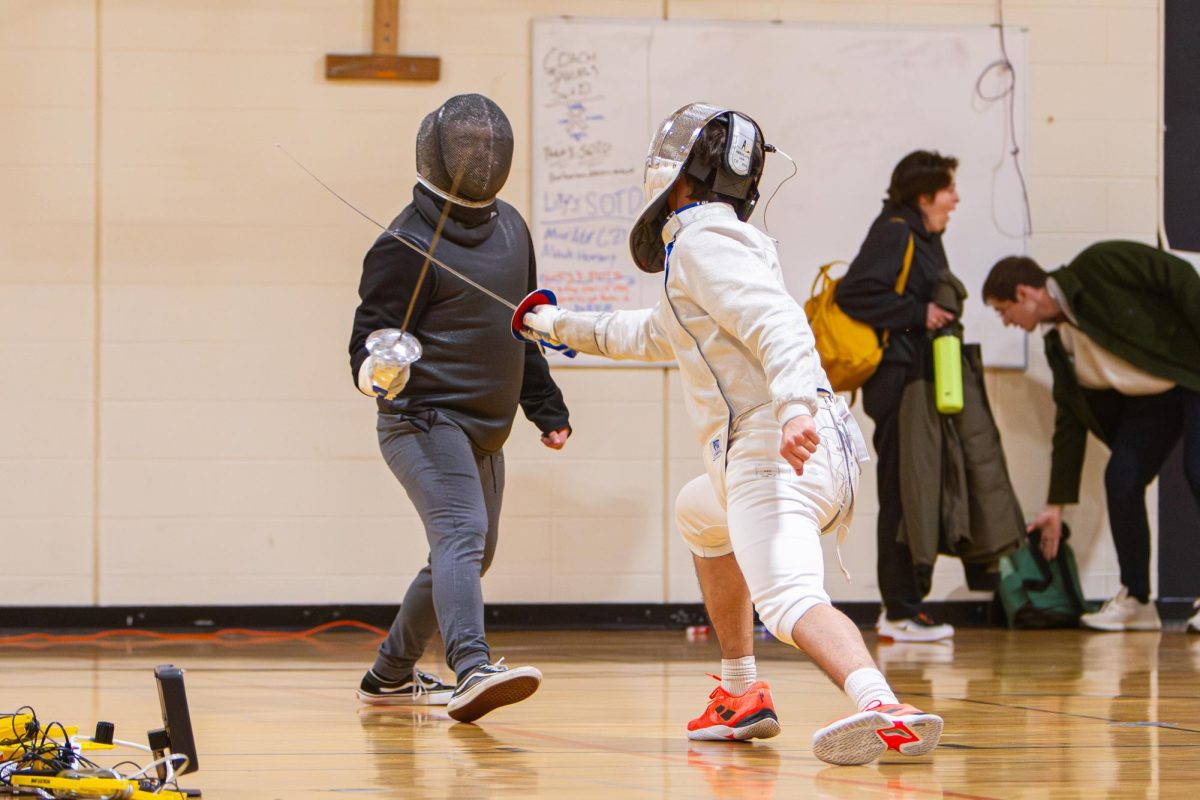
Two figures covered from head to toe in white armor, scampering wildly back and forth across a strip of platform with long shiny rods flying undetectably through the air. That is a fencing match–or at least what it might look like.
Unfortunately, this season, those long shiny rods didn’t exactly poke the right way for Evanston. Fifteen seniors from the team graduated last year, leaving a gaping hole in the roster. With the women currently holding a record of 5-4, and the men going 4-5, the team is in a rebuilding phase.
Still, there are many bright spots. Junior Lily Brosnan, the women’s foil captain, leads the way.
“She is on an absolute tear,” remarks head coach Andrew Stencel excitedly. “Last year she won conference championships, which is our version of state.” Brosnan went undefeated in the first four tournaments of this season. She remained untouched through the individual bracket, seeding round, and regular season team play.
“Nearly unprecedented in the conference,” said Stencel, who has no shortage of praise for Brosnan and her accomplishments.
To understand her accomplishments, though, one must understand the sport.
Fencing has three different disciplines: épée, saber, and foil. Each discipline has different rules on how and where to score points. Generally, a point is scored when the opponent is hit in a target area. The fencer with the most points at the end of the bout (or match) wins.
There are individual meets, and there are team meets. In individual meets, fencers go head-to-head with opponents and progress through pools and elimination phases. In team meets, each school has three épée fencers, three saber fencers, and three foil fencers. Each fencer plays every opposing fencer in his or her discipline. Once all the bouts have been fought, the scores from all three disciplines are added up to decide the winner.
Although the aggressive nature of the sport may be misleading, don’t let it fool you. Fencing at ETHS has many unique qualities that other programs don’t, and the gem is not found on the battlefield. In fencing, the girls and boys play separately during matches, but practice is fully coed.
“A big benefit to fencing is that it creates a more cohesive team environment. It lets everyone practice against different types of athletes,” says Stencel, speaking to the positive impact of a coed fencing team. “You end up with a lot of good friendships or a lot of good conversations that might not happen on a team otherwise.”
“I think there’s a lot of power in good team support. If it is just a men’s team or just a women’s team, you don’t always have that,” adds Stencel.
That support is definitely needed most from incoming freshmen, as the sport may be a bit challenging for newcomers.
“You have three weeks of practice, and then you are at your first tournament, even if you have never fenced before in your life,” said Stencel.
Relievingly for some, though, not everyone has to participate in the competition. Many students just show up casually to have a good time, wanting nothing to do with any tournaments, and that’s okay.
For those who do want to compete, however, there is certainly a place. The program has an impressive track record of producing successful and college-level athletes.
“There are also fencers who go to a club in the offseason. In the last three seasons, we’ve had three people go to NCAA programs.”
Which brings Stencel further, “Being able to build on what we already built, and just to keep going up and up and up is going to be huge for us.”
“Another big goal I have moving forward is that I want to keep working on recruitment. Just keep recruiting, keep turning kids through and giving them a chance to fence,” commented Stencel, after citing a recruiting challenge.
Currently, the team only has about 45 members across all four grades. However, with only three seniors graduating this year, the team has high hopes for a strong season in 2026-2027.
“There is no barrier to entry,” asserts Stencel, “other than your own desire to hit someone with a metal stick.”