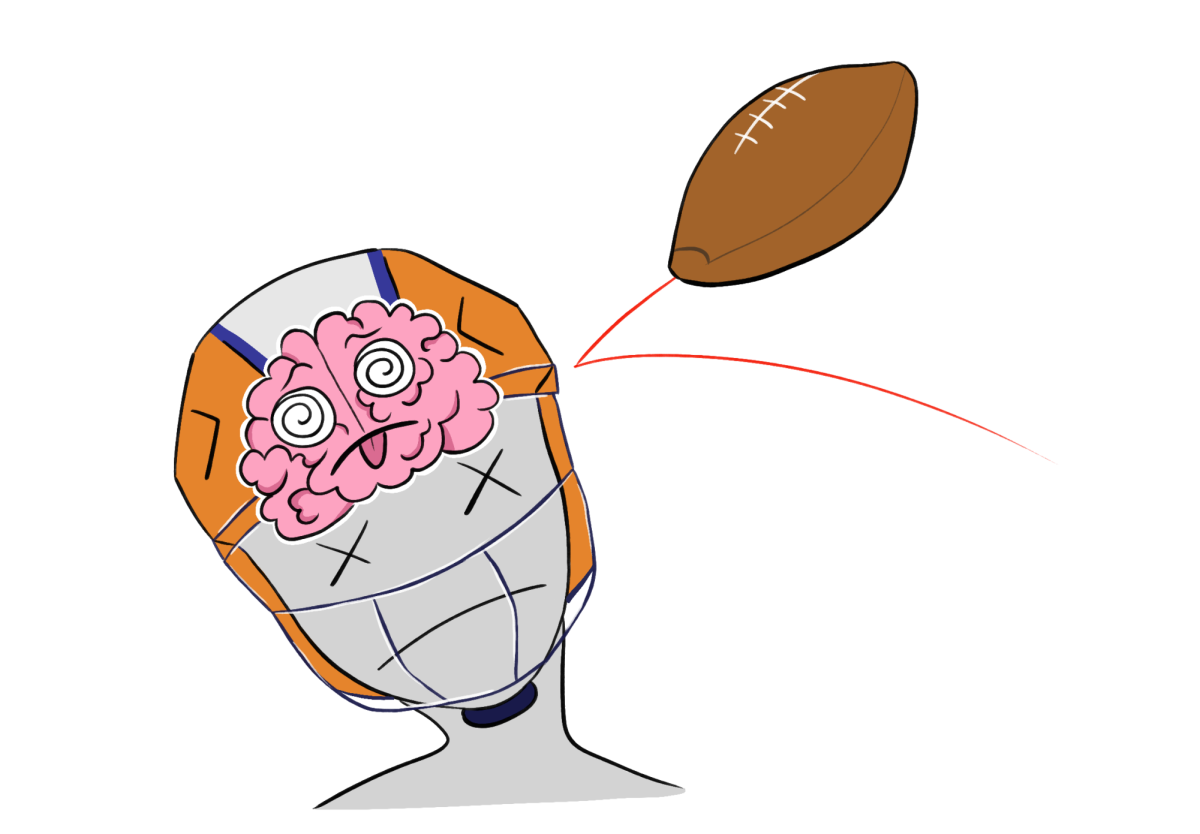
In 1920, when the NFL was founded, no one had ever heard of the term “CTE”. Now, more than a century later, it is one of the hottest topics going around the league. Three years ago, researchers at Boston University performed a study that tested 376 former NFL players and diagnosed 345 of them with some level of CTE. Although this stat may seem overwhelming and even a bit unreal, it is not all doom and despair. Every year, specialists are designing newer and newer football equipment in an effort to make it a safer game.
CTE, which stands for Chronic Traumatic Encephalopathy, is a degenerative disease that causes the death of nerve cells in the brain. It gets worse over time and can only be certainly diagnosed with an autopsy after death. Unlike the misleading myth, CTE does not only happen after severe concussions; it has also been found to appear after an extended period of time with only minor hits to the head.
The essential component of this is the age at which a child starts playing football. Many people diagnosed with CTE never played football past high school. Since the brain develops at a younger age, it is more vulnerable to violent blows.
“Youth football is critical in teaching the rules of the game. I don’t think 6-year-olds need to be playing,” claims Varsity football coach, Miles Osei.
That’s why it is so important to make football safe at the youth and high school levels, and it all starts with protecting the head.
“The head is the most important part of the body. [It’s our] number 1 priority,” acknowledged Osei.
For the same reason, though, many parents of high school students at ETHS will not let their children play football.
One thing to keep in mind is that CTE can develop decades after someone stops putting their body in danger. This means that many of the cases we are seeing of CTE destroying a former football player’s cognitive abilities are a product of football thirty years ago, not today.
The precautions being taken at a high school level today are unmatched by what they used to be. Helmets are developed with sensors in them that record every single impact, and pads have increased exponentially in safety.
The ways of teaching football have changed, too.
“There is more of an emphasis on how you tackle. No one teaches to lead with your head. If a coach does teach in that manner, they are certainly not a coach,” added Osei.
That may be true, but the rest of the picture cannot be overlooked.
In July 2025, Shane Tamura, a former football player who fatally shot four people and then himself in a Manhattan building, was diagnosed with CTE after his death. He had been playing football since he was six years old, and had suffered from chronic headaches his whole adult life. Tamura was only 27 when this tragedy occurred.
Even though this is an extreme example, this shows just how much CTE can affect a person, and why we need to make sure we find a solution to this problem so younger players don’t end up with this illness.
The next steps to increasing awareness and safety precautions for CTE in high school football not only hold the future of any hopeful young players, but also the future of the American football game itself.