Your choice of college major is one of the most important decisions of someone’s life. Mistakes in the ways that students pick majors can have detrimental impacts on their life trajectories. Alarmingly, recent research by Carnegie Mellon Professor John J. Conlon shows that US students greatly oversimplify their choice of major. Students vastly overestimate the likelihood that they will work in their majors’ stereotypical careers, not considering the risk of alternative careers, leading to them making costly decisions.
Further, these mistakes are not minor; there are countless glaring examples across some of the most popular majors. Currently, there are more American undergraduates majoring in journalism than the total number of journalists in the country. Likewise, there are more Psychology majors than accounting majors, even though there are nearly eight times as many accountants as psychologists. How can these facts possibly be the case? The new research paper provides evidence that these facts stem from systematically incorrect beliefs about the relationship between majors and careers. People vastly overestimate the likelihood that they will work in the stereotypical career for their major. First, across all majors, every single stereotypical career’s likelihood is overestimated. Further, when comparing different majors, big distinctions arise. 42% of communications/journalism majors expect to be communications/journalists; however, 4% actually become one. Similarly, 65% of art majors expect a career in art despite only 17% actually becoming artists.
At first glance, these overestimations may seem to be due to students being overly confident instead of overestimating the overall connection between major and career. However, the data shows otherwise. The study asked Ohio State students to assess the likelihood of students obtaining the typical job for their major for students other than themselves and majors other than their own. Because these students were asked about students other than themselves, it removed the influence of self-confidence. Across every major, these responses still vastly overestimated the relationship between majors and careers.
But is this stereotyping an issue? It all depends on how you view the alternative careers to your major’s stereotypical career. Only 20% of fine arts majors end up with careers in art; the rest wind up with extremely different careers. In fact, 15% have occupations in Management, 13% in education, and 9% in office and administration. If you are an arts major who chose the major because you want to become an artist but would be very unhappy in the non-art-related jobs listed above, then you may want to reconsider. On the contrary, economics majors become economists at an even lower rate of under 2%. However, the other jobs that they typically work are similar to those of economists, with most economics majors working in finance and business. Therefore, if you are someone who simply wants any occupation that has to do with money, then majoring in economics will not be risky.
With that said, majors that are high-risk are defined as ones where it is very unlikely that you will be employed in the stereotypical job for that major, and the jobs that you will likely end up with instead are low-paying.
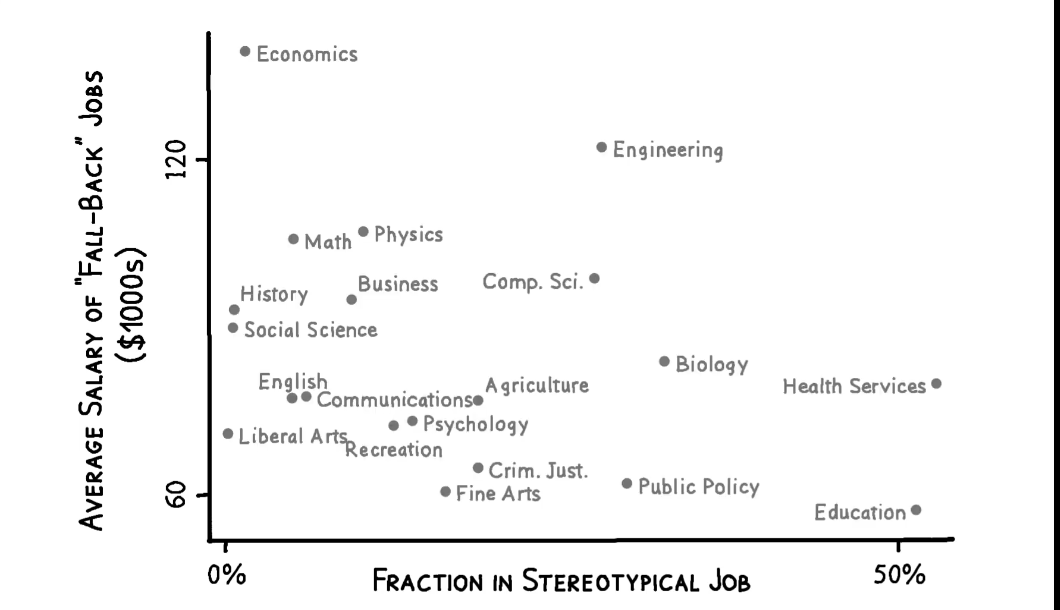
So which majors are risky? The riskiness of the most prevalent majors is graphed below:
Source: Mistakes in Choosing College Majors
In the top left, majors such as economics, math, and physics have a very low fraction of students in stereotypical jobs. But they are low risk because the alternative jobs are extremely high-paying. For example, most math majors don’t end up as math teachers, but when they don’t, they make a lot of money working math-heavy jobs, such as financial analysts. In the bottom right are health services and education. These majors can also be seen as lower risk, as although they do not have very high-paying alternative jobs, they have a high fraction of students in their stereotypical jobs. Towards the middle are comp sci, engineering. and biology. These majors can be considered very low risk due to their having both a higher fraction in their stereotypical jobs and high-paying alternative jobs.
Then, finally, majors such as liberal arts, recreation, fine arts, psychology, communications, and English that are in the bottom left region are the riskiest. For these majors, it is both rare to obtain the stereotypical job, and the alternative jobs are low-paying. So, the cost of overestimating the prevalence of the stereotypical job for a major is highest for students who chose majors in this region. These students are likely to find themselves both not in the job they wanted when they chose their major, and making little money in the other job they were able to obtain instead.
The Carnegie Mellon paper ended with a case study. The case study presented students with this data before they chose their major. The team observed that students who were presented with the data made different and “more responsible” decisions. They also found that the people whose choices were most affected by the data were those who especially overestimated the stereotypical outcome of a risky major. So next time you think about your major, ask yourself the question, how would you feel working in the alternative careers for your major?