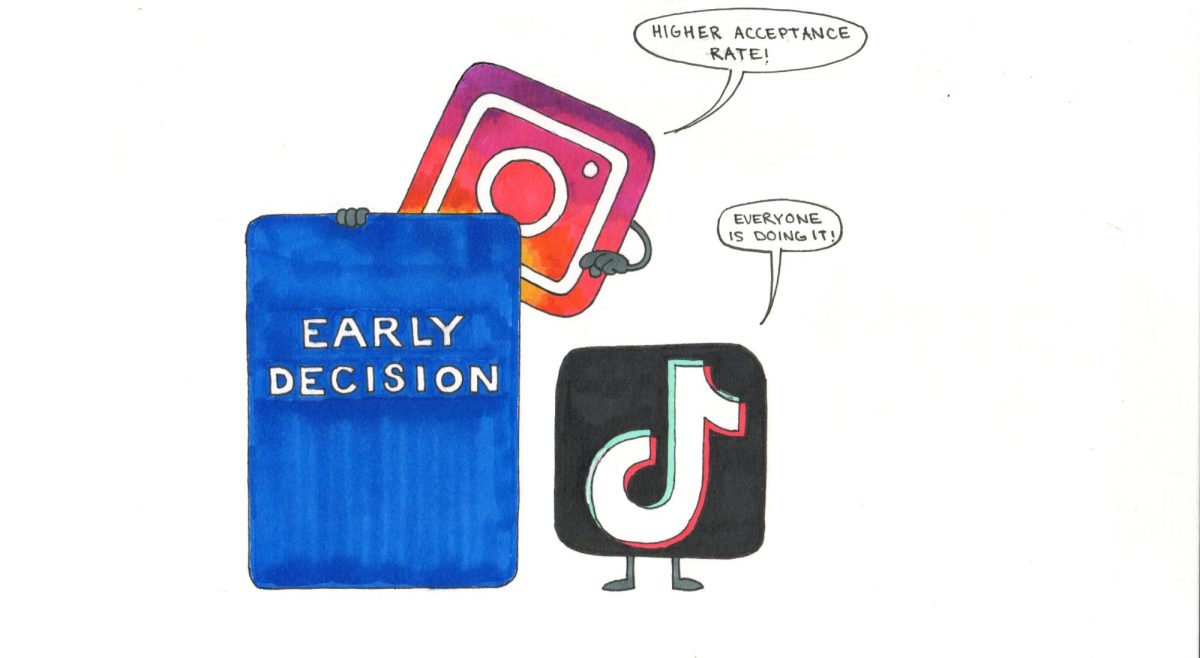
Among students, social media has created a culture of comparison and competition surrounding prospective students, contributing to a toxic environment surrounding college applications and admissions. During college admissions season, TikTok users’ For You Pages are flooded with thousands of seniors and college counselors sharing their statistics on what got them into various schools, sharing past essays, and soliciting advice.
“Seeing college counselors on my For You Page makes me nervous because they are always giving so much advice, it becomes overwhelming,” said senior Audrey Hurd.
The impact of social media spans beyond college admissions. In fact, the American Psychological Association reported that 41% of teenagers, with the highest social media use, rate their overall mental health as poor. Therefore, it is no surprise that during an already stressful time period, social media would exacerbate this feeling.
Social media has allowed teenagers to compare themselves beyond their social groups and schools — but to other students in different states and potentially different countries. For You Pages are flooded with thousands of seniors giving advice, students dressed in school merchandise opening an acceptance letter, and the comments that come with this content promote comparison amongst students.
“The worst thing on social media to me is everybody looking at the computer screen when they get their acceptance. I’ve never seen a rejection, and so it makes it an event,” said Heike Spahn, a private college counselor for Riley Baker Educational Consulting.
For a majority of students, their college admissions experience doesn’t mirror those presented on social media. By constantly viewing acceptance after acceptance, they feel isolated, even though both rejection and acceptance happen during the process.
It is more common than not to see high schools with admitted students pages, to see which college a senior has selected to attend. College admission time frames vary between different programs, so some students may have decided where they are going in December, while other students have to wait until as late as April to hear back from their schools.
“The student page is stressful because so many people are getting in, and a lot of my decisions come back later. So, it gives you more of a sense of competitiveness with others,” said senior Chesney Brown.
A large part of this competitiveness comes from early decision releases, and it creates a feeling of being left out or behind in the college process. Early decision is contractually binding — telling the university that they are unequivocally your top choice and that you will attend if accepted. Early decision is appealing to many students because you get your decision back months earlier, and universities tend to advertise a higher acceptance rate for their early decision applicants.
“[If] you apply ED and you’re set on that school, it’s heartbreaking if you can’t go because you can’t afford it,” said Spahn.
Though early decision is a great opportunity for students, it becomes an equity issue since, by being accepted early, you have to agree to their financial aid offer. Although you can negotiate the offer, it is a risky financial decision. As a result, students who are low-income are deterred from applying for early decision.
“Early decision becomes an equity issue with finances, [even] with the opportunity to know early decision as a thing, who gets in early decision, that kind of thing. The number of students that are now getting in early decision and the lack of diversity in that group of students, and then it closes the door for who’s left that could get into a class,” said Beth Arey, a college counselor at ETHS.
The toxic environment that college admissions have created comes from many different factors, and ETHS has tried to eliminate that feeling of competition amongst peers by not having class ranking. However, even the platform Schoolinks, which allows students to do post-high school planning, allows students to see data from past years of what students got into different colleges based on GPA and test scores.
Although college admissions are stressful and can feel like a competition, it’s important to remember that it is not a measure of a student’s worth. The culture surrounding social media and early decision has shifted the college admissions process into a race to see how many schools a person can get into, when they get into them, and how prestigious they are. However, it is important to shift attention away from comparisons online and with peers and to focus on how a specific college is beneficial to you as a student and a person.