While curiosity is often described as the heart of education, the pursuit of strong grades and college admissions has inevitably crept into our daily lives and shaped how we think about learning. At times, this mentality has sharpened our discipline and pushed us to achieve, but it also raises a difficult question: to what extent did school nurture our curiosity, and to what extent did it overshadow our desire to explore it?
This question is not new. Thinkers have been asking it for generations, an idea reflected in a line often attributed to Albert Einstein, who remarked that “it is a miracle that curiosity survives formal education.” Almost a century later, national research suggests that the survival of curiosity remains uncertain. A 2023 Gallup report found that only about one-third of high school students consider themselves actively engaged in their learning. Psychologists from Gallup argue that high school environments tend to reward accuracy, speed and task completion more than exploration or imagination, and that the pace of academic life leaves little room for exploring ideas simply because they are interesting.
“Creativity relies on dwell time, but we move so quickly that it is hard for students to enjoy the process,” said AP ChemPhys teacher Terry Gatchell, who has taught at ETHS for 13 years.
Teachers across a variety of subject areas echo the same internal tug-of-war. They want to create space for curiosity and passion, but the structure of their curriculum can sometimes make that easier said than done. ETHS offers a wide range of electives, project-based courses and independent opportunities, yet teachers note that the ability to lean into deeper inquiry depends heavily on the courseload. When curriculum guidelines are flexible, teachers can build space for discussion, experimentation and student-driven questions. When guidelines are tighter, the curriculum must come first.
“I have a lot of creativity and autonomy, but that is partly because I have been here for more than 25 years,” said English teacher Tammy Holmes, who teaches Senior English classes as well as a section of Freshman English. “I do not feel afraid to try something new.”
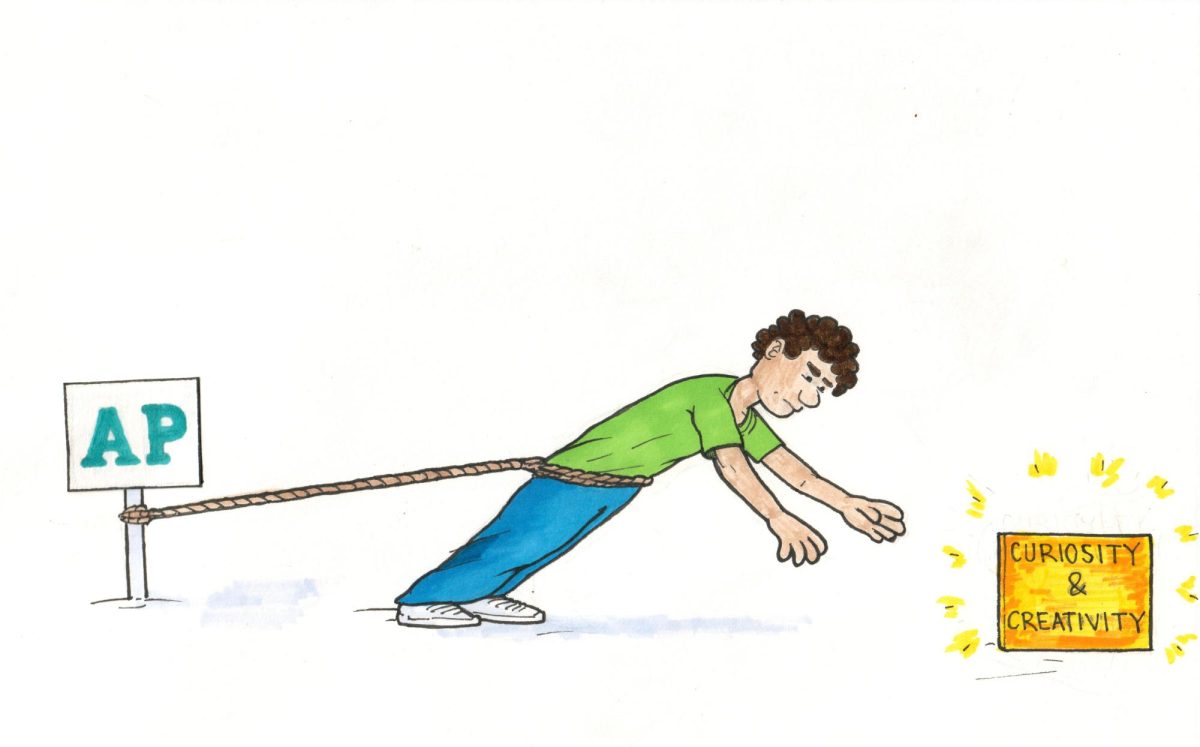
Teachers say the most significant limitations appear in classes tied to external exams. The AP programing at ETHS often requires strict pacing and a wide scope of content, and even teachers who deeply value creativity admit that AP structures leave little room for slow, reflective thinking. In many cases, the very courses most associated with rigor become the ones incapable of supporting niche curiosity.
“In AP courses there is so much content to cover,” said history teacher Jay Stanek, who teaches both AP and non-AP history. “In my regular U.S. class I can do more creative work, but in AP we are getting students ready for the test.”
Students feel this shift directly, especially those taking multiple AP courses at once. Younger students, meanwhile, often enter high school with a more open and curious mindset as they learn to balance academic ambition with discovery.
“My good grades and my interests usually line up, so I feel supported by my teachers,” said freshman Marina Joseph.
By the time students reach junior and senior year, the challenge becomes balancing genuine interest with the sheer volume of work required. One ETHS senior who wished to remain anonymous said AP demands often push him away from the subjects he used to enjoy. AI, he added, only exacerbates that problem because it offers a shortcut in moments when curiosity would normally take over.
“It feels like my curiosity dies when a problem is too hard, so I run it through ChatGPT before even trying,” he said.
He explained that this instinct does not come from laziness so much as the strain of balancing classes, activities and future plans.
“I have so much to do that it feels easier to get the work done fast instead of learning it slowly,” he said.
English teacher Anita Thawani Bucio sees the same pattern from the teacher’s side. She has taught both AP and non-AP English courses and says the difference is unmistakable. In courses with flexible expectations, students can pursue personal interests, ask their own questions and move at a pace that encourages depth. In AP courses, the structure is far less malleable.
“In AP there is more rigidity because students have to master the exam,” said Bucio. “In special topics classes there is more freedom and that helps students follow their passions.”
Many students say their teachers genuinely try to support curiosity, but the structure around them still rewards efficiency over discovery. By junior and senior year, college admissions and GPAs shape decision-making in ways that can cloud personal interest.
A study from the Harvard Graduate School of Education suggests that curiosity thrives when students feel ownership over their learning, yet highly competitive environments can nudge students toward strategic behavior instead of intellectual risk-taking.
This is not to say that ETHS is failing students; in many ways, it is quite the opposite. The school is among the best public high schools at supporting curiosity, with caring teachers and a wide range of courses that let students explore new interests. Many students feel they have real opportunities to engage with material that goes beyond the basics.
Nevertheless, the broader expectations tied to challenging classes make it almost impossible for curiosity to consistently remain the priority. For many students, taking AP classes is about pushing themselves and joining a community of peers who want to be there and care about the subject. That mindset has become a big part of how high school operates. While AP classes can be valuable for students who want more challenge, they can also come with trade-offs that affect how much curiosity fits into the course.
“There’s too much focus on the outcome, what grade you get or what school you get into,” said senior Nikolai Drobyshevsky. “People don’t enjoy the process anymore, and they aren’t learning for the sake of learning.”